
Most people become managers because they were brilliant at their last job.
Then the job changes.
Yesterday, you were measured on your own work. Today, you are measured on how well other people think, decide and perform. That is a different skill set, and very few of us are formally taught it.
I see this every week as a leadership and management trainer, in London and with teams across Europe, Latin America and Asia. Talented, hard-working professionals step into leadership and quietly wonder why the strengths that got them promoted no longer feel like enough.
Here is the shift in one sentence:
When you lead, communication stops being part of the job. It becomes the job.
Your clarity becomes the team’s clarity. Your calm becomes the team’s calm. And your silence gets interpreted, whether you intend it or not.
In this article, I want to share something practical from my work with new and experienced managers: the three conversations that, in my experience, separate managing from leading.

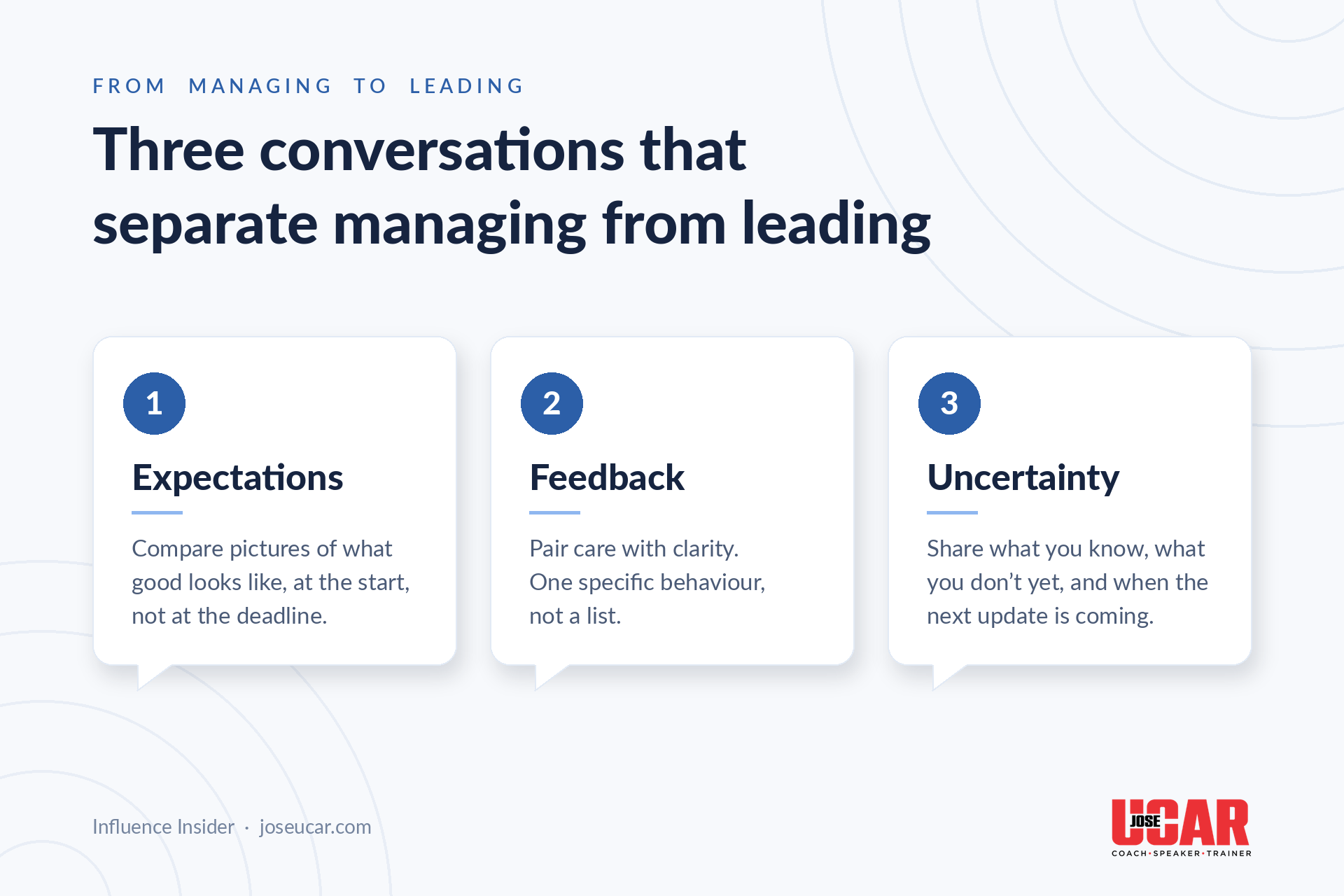
1. The expectations conversation
Most friction inside teams does not come from laziness or bad attitudes. It comes from two people holding two different pictures of what good looks like, without ever comparing them.
The manager assumes the brief was clear. The team member assumes they understood it. Weeks later, there is frustration on both sides.
Try this: at the start of a piece of work, ask the person to describe what success looks like in their own words. Not to test them, but to compare pictures. Where the pictures differ, that is the real conversation, and it is far cheaper to have it now than at the deadline.
2. The feedback conversation
Avoiding feedback can feel like kindness. It rarely is.
When we hold back what someone needs to hear, we are often protecting our own comfort rather than their growth. It is hard for people to improve based on a message they have not received.
Try this: pair care with clarity. Open with intent (I am sharing this because I want you to succeed), then describe one specific behaviour, the impact it had, and what good would look like instead. One behaviour, not a list. Feedback lands better when it feels like a hand on the shoulder, not a verdict.
3. The uncertainty conversation
During change, silence creates stories. When leaders go quiet, teams tend to fill the gap with their own version of events, and it is usually more negative than reality.
Many managers stay quiet because they do not have all the answers yet. Understandable, but costly.
Try this: share what you know, what you do not know yet, and when people can expect the next update. That structure sounds simple, and it builds more trust than polished reassurance. People can handle uncertainty. What they find harder is feeling forgotten.
One question to carry into next week
Before your next one-to-one or team meeting, pause and ask yourself:
What do I want this person to think, feel and do after this conversation?
If you can answer that before you speak, you are already leading with intention rather than reacting on autopilot. That small moment of preparation lifts the quality of almost every conversation that follows.
Go deeper
- The full approach behind this article sits inside my Leading and Managing Effectively programme. You can download the brochure here for an overview of what it covers.
- For more free, practical videos on communication and influence, visit my YouTube channel.
- And if influence and communicating across cultures interest you, that is the heart of my book, Global Influence.
A short note on how I can help
This article draws on Leading and Managing Effectively, an interactive, experiential programme for professionals stepping into leadership, first-time managers and established leaders refreshing their approach. I deliver it in person and online, in London and internationally.
If your organisation is developing its managers this year, you can explore all of my training and coaching programmes here, each with a brand new brochure. Or email me directly at [email protected] and we can take it from there.
And if now is not the time, that is absolutely fine. My hope is that the three conversations above are useful on their own.
Which of the three conversations does your team need most right now? Leave a comment, I am always happy to hear from my readers.
It’s all about IMPACT🌎
Jose